
Richard Ashworth (headmaster)
Article by; Kaya Emin
|
|
Richard Ashworth (headmaster) Article by; Kaya Emin |
|
Richard Ashworth (16 April 1869–25 December 1928) was an English headmaster, known for his role as the first headmaster of The Latymer School on Haselbury Road in Edmonton, London, from 1910 to 1928. Beginning his career as a teacher in Tottenham, he led several schools, including the successful Tottenham Pupil Teachers' Centre, before overseeing the growth of Latymer from a small institution into a major secondary school. Ashworth was also a prominent figure in local civic life, known for his activism in the Liberal Party and his public lectures on social reform. |
|
Early life and education
Richard Ashworth was
born on 16 April 1869 in Tottington, a village near Bury in south
Lancashire. His
father, Robert Ashworth, worked as a calico printer and part-time
farmer, while his mother, Alice Ashworth, was a power-loom weaver. He
had two younger siblings, a brother named Joseph, born in 1871, and a
sister named Lilian, born in 1877.
Ashworth's early
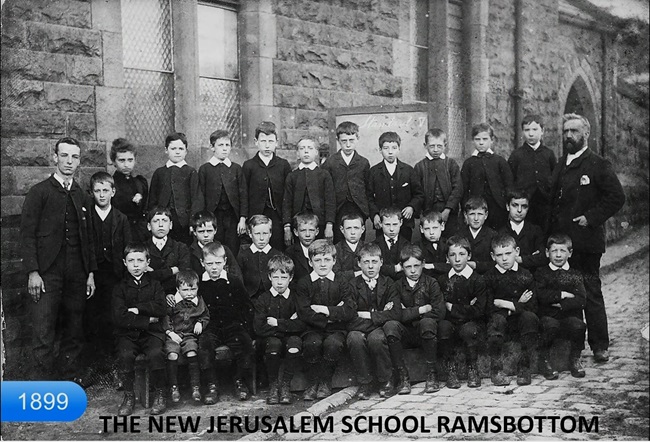
education is not well-documented, but at the age of twelve, he attended
the New Jerusalem School in Ramsbottom. The school focused on subjects
like mathematics and science, which Ashworth pursued with interest.[7] At
sixteen Ashworth received a modest inheritance which helped support his
further education. He worked as a pupil-teacher while studying, and in
1887, he received a Queen's Scholarship to Homerton College in London.
ROBERT ASHWORTH (SENIOR) WAS A CALICO PRINTER
|
|
 |
 |
|
Career Tottenham
After completing his
training at Homerton College, Ashworth began his teaching career
in Tottenham. He first held a probationary post at Seven Sisters School.
Shortly after in 1890, Ashworth secured a formal appointment as
an Assistant Master at Noel Park Boys' School.
The selection
process was highly competitive; the board minutes record that Ashworth
was selected only after three rounds of balloting by the board members,
eventually securing the post with an annual salary of £70.
In
1892, at the age of twenty-three and still on probation, he was promoted
to the boys' department at the Lancastrian School, a large institution
in one of Tottenham's poorest areas. The school faced severe challenges,
including extreme poverty, high truancy rates, and frequent epidemics of
scarlet fever and smallpox.
Despite these
difficulties, Ashworth became known for his dedication and was noted for
his ability to maintain discipline and improve attendance, frequently
deputising for the headmaster. During this period, Ashworth continued
his own studies, completing a B.A from the University of London in 1899.
|
||
 SEVEN SISTERS SCHOOL |
 Noel Park - Photo-Courtesy Bruce Castle Museum |
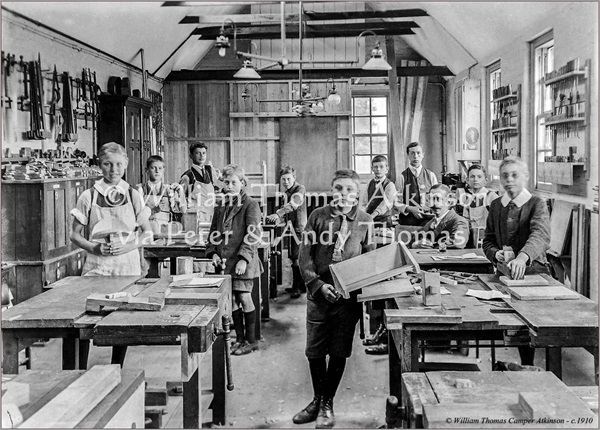 Lancasterian School 1910 Photo Courtesy - Andy Thomas |
|
In 1900, Ashworth
was appointed headmaster of Woodlands Park Boys' School in Tottenham.
Under his
leadership, the school saw rapid growth, with the number of students
increasing significantly. Ashworth's management and teaching methods
were praised in annual inspections, and the school's success reflected
his effective organisation, enthusiasm, and commitment to both his staff
and students.
In February 1904,
Ashworth was appointed Principal of the Tottenham Pupil Teachers'
Centre, succeeding the late Mr. T. E. Margerison.[
Upon his departure
from Woodlands Park to take up the role, the second master, Mr. Emery,
noted that the staff 'could not have had a more considerate' headmaster.
Under his care, the
Teachers Centre expanded rapidly, and its students achieved the highest
percentage of success in the preliminary examinations
in the country.
However, the
educational philosophy shifted, leading to the proposal for the
abolition of such centres.
The Tottenham Centre was closed down in July 1910. The official note marking its closure included a tribute to Ashworth's work. |
||
|
Personal life
Ashworth married
Caroline Lydia Joscelyne, on 2 August 1896. They had met the same year
while studying at the University of London. The couple had no
children. Ashworth resided in Tottenham and later Edmonton.[54] Beyond his professional duties, Ashworth was
deeply embedded in the civic and political life of his community. He was
a committed activist for the Liberal and Radical Party, serving as an
honorary secretary for local branches and frequently appearing as a
speaker or chairman at political meetings.
Ashworth was also a
prominent figure in the Pleasant Sunday Afternoon movement, a
non-denominational public forum where he delivered numerous lectures on
pressing social issues like poverty, revolutions, housing, and
education. In his later years, Ashworth took up golf and driving a motor
car, but found both stressful, which colleagues speculated may have
contributed to his declining health.
In late 1928, likely
driven by mounting professional pressures, Ashworth became a Freemason
and the first initiate of the Edmonton Latymer Lodge, but he died before
ever attending a meeting.
On 25 December 1928, Ashworth died of pneumonia
in Porthcawl
Wales, after contracting a chill during a train journey for a holiday.
He initially seemed to recover but suffered a fatal relapse on
Christmas morning.
Ashworth's funeral
was held on Monday, 31 December 1928. The service began at All Saints
Church, Edmonton
which
was described in a contemporary report as "crowded," before proceeding
to a graveside service at Edmonton Cemetery. The funeral was attended by
several hundred people, Pupils from Latymer School occupied the north
and south aisles of the church. |
 EXTRACT FROM THE TOTTENHAM & EDMONTON WEEKLY HERALD |
|
Addendum - Personal Life.
We have discovered during our research that
Caroline Lydia Ashworth (nee Joscelyne) was the aunt of Ralph Joscelyne
who was tragically shot and killed during ‘The
Tottenham Outrage’ in January 1909.
The Tottenham Outrage is perhaps one of the most
famous incidents in Tottenham's History, which at the time was of
widespread public interest at both local and national levels. |
 |
Article prepared and adapted from original Wikipedia page created by Kaya Emin April 2026


